Tea-service
Haas & Czjzek Horní Slavkov (Schlaggenwald), Bohemia, 1924–1927
Glazed porcelain, decorated with a gold band of tiny three-leaf clovers
UMP 24913
Donated to the museum by Carol Noble, Seaford, England, on 19 September 2017
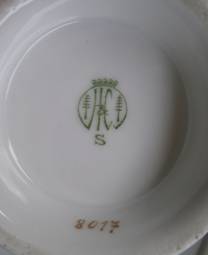
A service with a history
Manufactured at Haas & Czjzek porcelain manufactory, the service belonged to the family of Erika Stark, who died in Stuttgart in 2000. Erika was the distant cousin of Carol Noble, who decided to return the porcelain to where it had come from, to the country where their ancestors had roots.
Decorated with fine gilding, the Schlaggenwald service had been given to Erika Stark’s father as a wedding present upon his marriage to Erika’s stepmother, Elisabeth Löbl. Erika’s father was a Prague German, born in Prague in 1886. He met his second wife in Podbořany, where he worked as a high-ranking administrative official. Elisabeth’s family had lived in Podbořany since the eighteenth century, and were among the town’s reputable grain merchants and growers of the famous local hops.
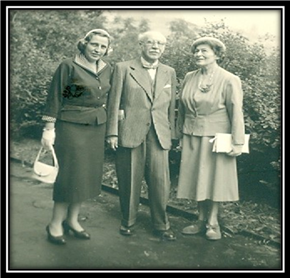
from right to left: Elly Löbl-Leitzer with her husband Karl and daughter Erika
In 1927, Erika’s father’s family moved to Trutnov, where her father was newly appointed as the vice-chairman of the Trutnov District Office. Ten years later, he became an official at the Ministry of the Interior in Prague, and the entire family moved to Arbesovo Náměstí in Prague–Smíchov. Here they lived until Hitler’s arrival in 1939. The fact that Elisabeth had married a German protected her from being sent to a concentration camp up until January 1945, but at the very close of the Second World War she was deported to Theresienstadt/Terezín. And as punishment for refusing to divorce his wife of Jewish origin, Erika’s father was conscripted into forced labour. Both survived the war, reuniting at their flat on Arbesovo Náměstí. However, after the war their daughter, Erika, had to leave them – due to her German origin, she was expelled from the country and resettled in Stuttgart. Curiously, her father was able to avoid expulsion and could remain in Prague – because he was married to a Jew. And so the porcelain service remained in Bohemia up until the last spouse died in 1980. Then it found a new home in Stuttgart. After Erika died, it and other family heirlooms were brought to Carol Noble in England. When she received the inheritance in 2008, she pondered the fates of each member of her family and her friends who were closely connected to Pilsen, but had never returned to Pilsen after the war. She decided to donate the porcelain service to a place so closely entwined with the fates of many of her relatives so it could serve as a reminder of times past, an old world which expired together with those close to her.
Such as Paula Löbl (Carol’s great-grandfather’s sister), who had lived in Pilsen with her husband, Bernard Wölfler, from 1891 until January 1942, when they were deported to Theresienstadt. Bernard died five months after the transport, and Paula was sent to Treblinka, where she was murdered. Of her four sons, only the youngest survived; the others, together with their families, died in concentration camps. The youngest son, Rudolf Wölfler, had married Ella Weiner, the daughter of Karl Weiner, who had commissioned Adolf Loos to decorate the interior of his home on Náměstí Republiky in Pilsen. Rudolf Wölfler, his wife Ella, and their daughter Hana survived the war in England and returned to Czechoslovakia in 1945.
Her uncle Max Löbl (Carol’s great-grandfather’s sister) had fled from the Nazis after the annexation of the Sudetenland, arriving in Pilsen and remaining up until his death in 1939. He is buried at the New Jewish Cemetery in Pilsen. His wife Rosa and son Franz were deported to Theresienstadt in January 1942. In May they were sent on to Sobibor, where they were murdered.
While the superior quality of the porcelain used for the service combine with the simple decoration to make a very elegant impression, it was a standard feature in every middle-class family. Its value and importance, however, lie at a completely different level. It should be a connection to the time from which it speaks to us. Joining it in the glass case are remnants of the fates of the people to whom the service had belonged or who visited Elisabeth for afternoon tea in the winter of 1942 for the very last time.